
Native Advertising: Formats, Disclosure, and Measurement
May 9, 2026
Author: Shusaku Yosa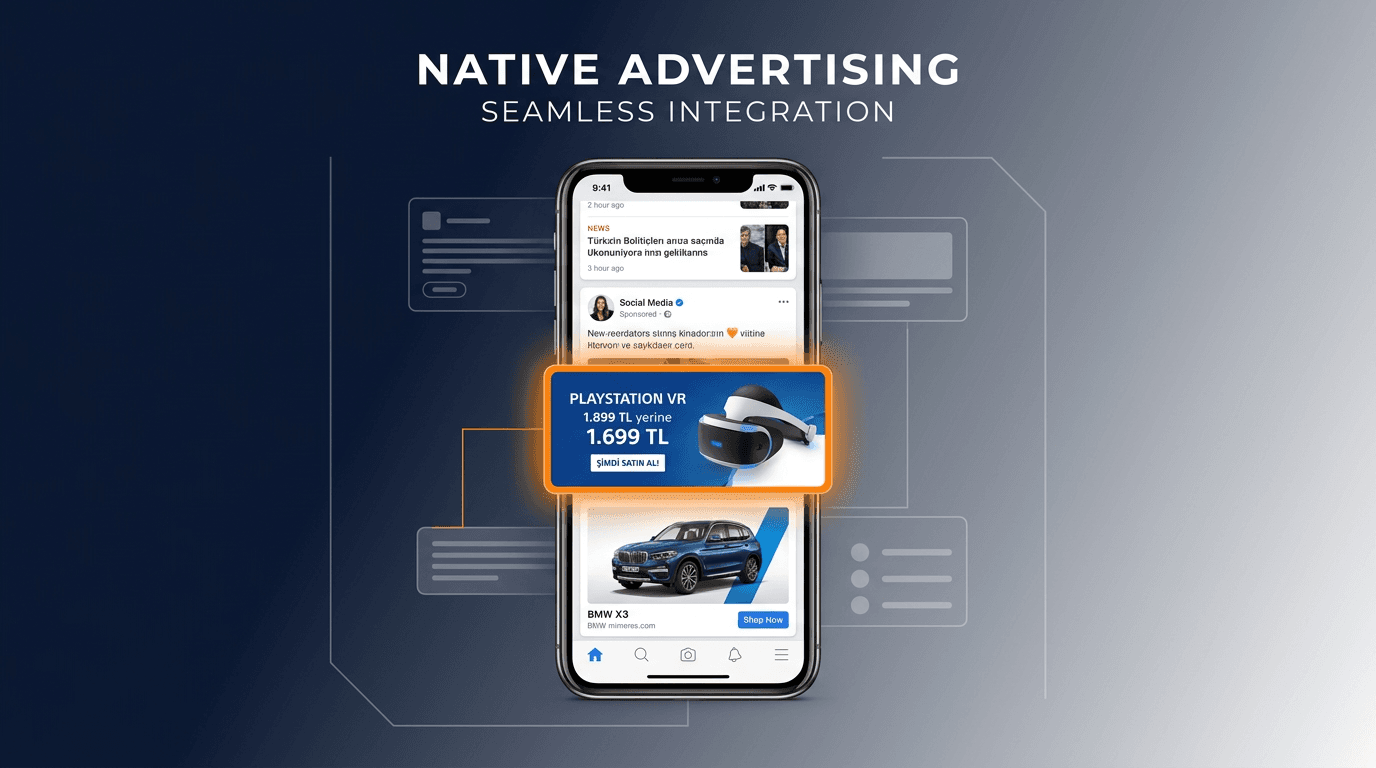
Native advertising is designed to fit the format and context of surrounding content. It aims to be relevant and readable, not to conceal its commercial purpose. Readers should understand who is advertising and what is being offered.
Placement, format, delivery service and pricing model are separate dimensions. “Native” does not automatically mean cost-per-click buying or superior campaign results.
Compare the formats
Example format | Context | What to review |
|---|---|---|
In-feed ad | Social or news feed | Disclosure, creative and destination |
Recommendation ad | Suggested-content area | Separation from editorial recommendations |
Branded content or sponsored article | Longer editorial-style explanation | Sponsorship, production and review responsibilities |
IAB updated its earlier classification in the 2019 Native Advertising Playbook 2.0. See IAB’s overview rather than treating the older six-category list as the sole current model. In a media proposal, the actual placement, format and contract are more useful than a broad category label.
A sponsored article is one possible native format. Content marketing is a wider practice of providing useful information over time, not a specific paid placement. Related guides cover in-feed advertising and internet advertising types.
Choose evidence from the objective
Objective | Define first | Important limitation |
|---|---|---|
Explain a problem | Intended audience and understanding | An impression does not prove understanding |
Support consideration | Relevant next-step actions | Check accidental or automated visits |
Generate demand or orders | Validated inquiries or purchases | Deduplicate and account for cancellations |
A high CTR can be unhelpful if a sensational headline attracts the wrong audience. For a long buying cycle, agree on follow-up time, but do not use delayed outcomes as an excuse for unlimited spending. Set a review date and budget boundary.
A fictional B2B campaign
Imagine a software business promoting an article about monthly reporting, then offering a detailed checklist. This is an editorial planning example, not a reported customer result.
Component | Design |
|---|---|
Audience | People responsible for consolidating reports |
Promise | Practical steps for reviewing the workflow |
Destination | An article explaining steps and limitations |
Next action | View or request the detailed checklist |
Evaluation | Relevant requests, sales conversations and handling effort |
Change/stop conditions | Misleading content, broken measurement or budget breach |
Suppose a Japan-based test costs JPY 200,000 in media, JPY 150,000 in production and JPY 50,000 in management, and produces 20 qualified requests. Total cost per request is JPY 20,000, while media-only cost is JPY 10,000. These are fictional assumptions, not market rates or expected results.
Treat disclosure as part of design
For campaigns in Japan, the Consumer Affairs Agency explains rules concerning commercial representations that consumers cannot readily recognize as such. Consult its stealth-marketing guidance, in Japanese. A tiny “PR” label somewhere on a page is not a universal compliance solution. Other jurisdictions have their own requirements.
Review whether the disclosure and advertiser are understandable, visible on mobile and consistent across the ad and destination. Testimonials, comparisons, health claims and prices require their own substantiation and applicable review. Platform approval is not a guarantee of compliance with every relevant law.
Launch and review checklist
- Match the headline and image to the destination’s actual content.
- Never improve CTR by making sponsorship harder to recognize.
- Check mobile readability and the next action.
- Agree on rights, revisions, placement duration and reuse.
- Define outcome collection, duplicates, cancellations and total cost.
- Record campaign changes and the review date.
A readable advertisement can still be clearly identified as an advertisement. Preserve that distinction, and compare platform reporting with validated business outcomes before deciding whether the campaign deserves further investment.
Related guides
- What Is Criteo? Products, How It Works, and Setup Requirements
- How to Write a B2B White Paper: Outline, Distribution, and Follow-Up
Review your results consistently
For ongoing data aggregation, comparison and reporting, review NeX-Ray’s integrations and features. Check the plan requirements for your analysis, then start for free.
Sources and verification
References checked on October 1, 2026. The examples and worksheets in this article are editorial illustrations, not reported customer results.